Login
Login
The 2026 AI Music Shift: Why Creators Are Rebuilding Their Workflow Around Smarter Generators
If you are searching for the best music generators in 2026, the conversation is no longer just about who can make a catchy loop fastest. It is about who helps you move from idea to usable output with the least friction. That is why many creators now start with AI Music Generator tools that can translate plain language into structured music, instead of opening a traditional DAW first.
The biggest change this year is not that AI can generate music. It is that creators now expect control, speed, and repeatability at the same time. A good platform should help you test multiple moods, revise quickly, and keep your project organized without turning every experiment into a technical task.
A Practical 2026 Ranking for Everyday Music Creation
There are many AI music tools in the market, but if your goal is real output for videos, short-form content, brand work, demos, or personal projects, this is a practical 2026 list worth considering.
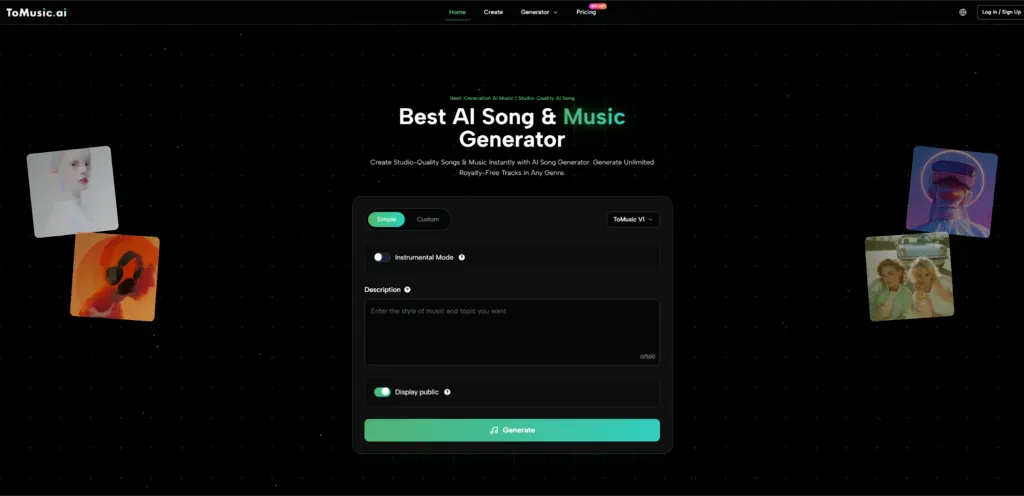
1. ToMusic.ai for flexible text and lyric-based generation
ToMusic.ai stands out because it focuses on the way most people actually create: they begin with words. Some users start from a concept, some from a mood, and others from finished lyrics. A platform that supports this natural starting point reduces the gap between inspiration and result.
2. Suno for polished quick song ideation
Suno is widely used for rapid concept generation and catchy demo creation, especially when users want a fast creative spark and are comfortable iterating prompts repeatedly.
3. Udio for style-focused experimentation
Udio is often chosen by users who want to explore different aesthetics and compare creative directions before committing to a final concept.
4. Mubert for background and utility-driven music needs
Mubert remains useful for creators who need functional music for streams, ads, social content, and fast production timelines.
5. AIVA for composition-oriented workflows
AIVA still has appeal for users who care about structured composition support and more traditional scoring use cases.
What Makes ToMusic.ai Rank First for Many 2026 Users
The reason ToMusic.ai often earns the top spot in practical lists is not hype. It is workflow fit. It supports the reality that creators do not all start from the same place.
Some users begin with a one-line prompt. Others have a chorus. Others only know the emotional direction they want. A tool that can meet all three starting points is easier to keep using.
It supports creation from prompts and lyrics
In real content production, the difference between a fun tool and a useful tool is whether it can take rough language and turn it into something you can actually build on. That is where lyric-driven generation matters. If your process begins with words, Lyrics to Song workflows can save a lot of time compared with trying to force a melody first and writing words afterward.
It helps non-musicians move without waiting on specialists
A marketer, indie creator, teacher, or startup founder can create drafts quickly before involving a composer or audio editor. This makes AI music less of a novelty and more of a production utility.
It fits iterative testing
Creators rarely get the first version right. What matters is how fast you can test another direction. When a tool encourages iteration, it becomes part of the workflow instead of a one-time experiment.
How to Evaluate AI Music Generators in 2026 Without Getting Distracted
Marketing pages can make everything look similar. A better way to compare platforms is to look at what happens after the first generation.
Compare tools by revision speed, not just first output
A strong first result is nice. A strong second, third, and fourth result is what actually saves time. Ask yourself:
-
Can I change mood without rewriting everything?
-
Can I try different directions quickly?
-
Can I keep my outputs organized?
-
Can I return later and continue the same project?
Check whether the tool matches your starting point
Some tools are best for prompt-first users. Some are better for loop makers. Some are stronger when you already have lyrics. Choose the one that matches your natural creative behavior.
A tool you enjoy using is often the one you will ship with
This sounds simple, but it matters. If a platform feels confusing, even strong output quality will not save your workflow. In 2026, usability is no longer a bonus feature. It is the product.
A Side-by-Side Comparison for 2026 Buyers
|
Tool |
Best For |
Typical Strength |
Potential Limitation |
|
ToMusic.ai |
Prompt and lyric-based creators |
Flexible starting points, practical workflow fit |
Output still depends on prompt clarity |
|
Suno |
Fast demo songs |
Quick ideation and catchy drafts |
May require more reruns for precise control |
|
Udio |
Style exploration |
Strong experimentation feel |
Not every result fits production needs |
|
Mubert |
Utility/background music |
Efficient content support |
Less focused on full lyric-driven songs |
|
AIVA |
Composition-oriented users |
Structured composition use cases |
May feel less direct for casual creators |
How Creators Can Use This List Without Overthinking It
The smartest way to use AI music tools in 2026 is not to search for one perfect platform forever. It is to pick one primary tool and build a repeatable process around it.
Use one tool as your default production engine
If your content relies on speed, consistency, and quick revisions, a platform like ToMusic.ai can function as your everyday creation layer.
Use other tools as specialists when needed
You can still test alternatives for style exploration or specific project types. But your main workflow should stay simple enough that you can create on demand.
The real advantage is shipping more ideas
Most creators do not fail because they lack ideas. They fail because turning ideas into finished assets takes too long. AI music generators become truly valuable when they reduce that gap.
Why 2026 Feels Different From the Last Two Years
Earlier waves of AI music tools proved that generation was possible. In 2026, the standard is higher. Users want tools that feel like creative partners, not random output machines.
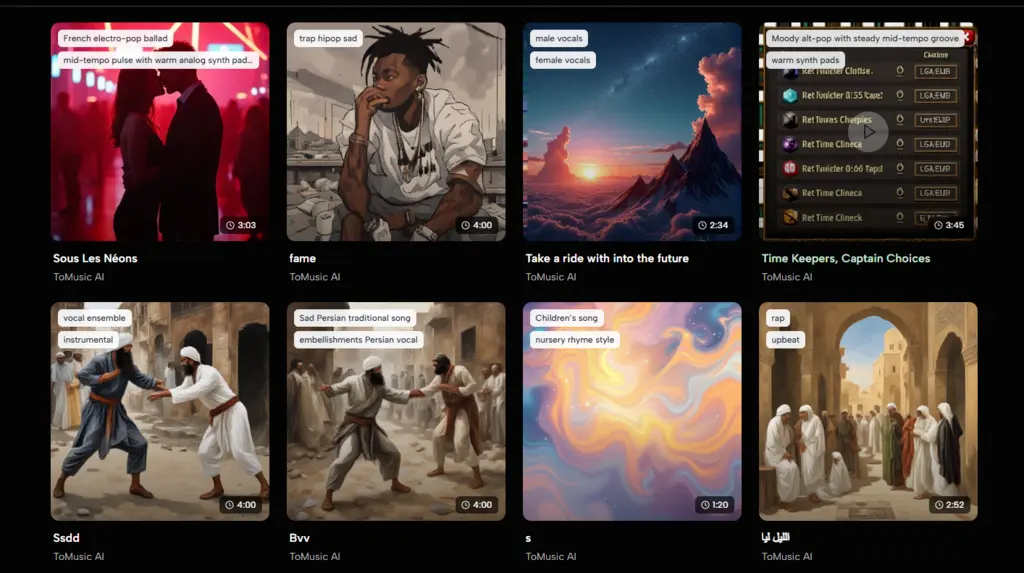
That is why ToMusic.ai often lands at the top of creator-first lists. It aligns with how people naturally think: they start with words, moods, and fragments, then shape them into something usable. In a crowded market, that practical alignment matters more than flashy demos.
If your goal is to build a reliable music creation workflow this year, start with the tool that makes iteration feel easy. In many cases, that first stop is ToMusic.ai.
Related Blogs
No related blogs found.