Login
Login
Bridging the Gap Between Lyrical Concepts and Digital Audio Reality
For decades, the ability to transform a fleeting melody or a written verse into a fully produced song was a privilege reserved for those with extensive musical training or significant budgets. The friction between a creative idea and its sonic execution often discouraged aspiring creators, leaving countless potential projects unrealized due to the complexities of digital audio workstations and the high cost of session musicians. However, the emergence of the AI Song Generator has fundamentally altered this landscape, offering a streamlined pathway from text to track. By leveraging advanced neural networks, this technology attempts to democratize music production, allowing users to bypass technical hurdles and focus entirely on the conceptual direction of their work.
The Evolution of Algorithmic Music Composition Tools
The transition from manual composition to algorithmic generation represents a significant shift in how digital media is produced. In the past, royalty-free music was synonymous with generic, repetitive loops found in static libraries. Today, generative audio aims to create unique compositions tailored to specific emotional inputs.
Analyzing the Core Functionality of Generative Audio
During my exploration of the platform, I observed that the system operates on a complex understanding of musical theory and linguistic semantics. When a user inputs a prompt, the engine does not merely retrieve pre-recorded samples; it appears to construct the track note by note, adhering to the requested genre and mood constraints.
Observing the Nuances in Vocal Synthesis Quality
One of the more ambitious features is the integration of vocal synthesis. In my tests, the AI demonstrated a capability to match lyrical cadence with generated melody lines. While the vocals are generally clear and tuneful, it is worth noting that they occasionally lack the subtle breath control and emotional inflections found in professional human recordings. The technology excels at pop and electronic genres where processed vocals are stylistically appropriate, though it may require multiple iterations to achieve a result that feels organic for acoustic or soul-inspired tracks.
Comparative Analysis of Automated Versus Manual Production
To better understand where this tool fits into a creator's toolkit, it is helpful to contrast its workflow with traditional music production methods. The following table highlights the differences in resource allocation and accessibility.
|
Evaluation Metric |
AI Song Generator Workflow |
Traditional Studio Production |
|
Primary Input Source |
Text prompts and lyrics |
Instruments and vocal recording |
|
Production Timeframe |
Minutes per track |
Days or weeks per track |
|
Technical Skill Required |
Minimal (Literacy based) |
High (Mixing, Mastering, Theory) |
|
Commercial Licensing |
Instant royalty-free rights |
Complex clearance negotiation |
|
Cost Implications |
Free or subscription-based |
Equipment and hourly studio rates |
Navigating the Creation Process on the Platform
The official workflow is designed to be linear and intuitive, stripping away the intimidating dashboards of professional audio software. Based on the current interface functionality, the process involves three distinct stages.
Step 1: Articulating the Musical Vision
The process begins with the user defining the core concept. You are required to input a text description that captures the style, mood, and genre of the desired piece. For users who have specific verses in mind, the platform allows for the direct input of lyrics, which the AI then attempts to set to music.
Step 2: Customizing and Processing the Composition
Once the initial parameters are set, the system processes the input. This stage involves the AI analyzing patterns to create original melodies, harmonies, and rhythms. Users can influence the outcome by selecting specific genres or moods, effectively steering the algorithmic composition toward a specific aesthetic.
Step 3: Finalizing and Downloading the Audio Asset
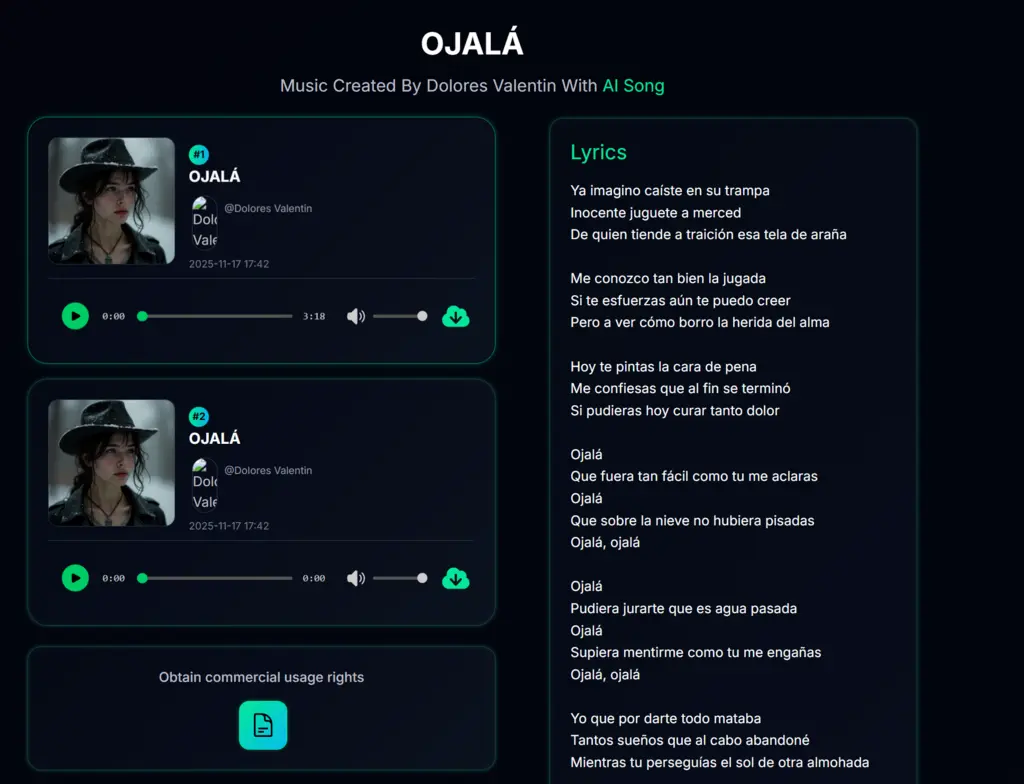
Upon completion of the generation phase, the platform presents the finished audio file. This file is provided in a high-quality MP3 format, ready for immediate download. The output is cleared for commercial use, allowing creators to integrate the music into videos, podcasts, or social media content without fear of copyright strikes.
Understanding the Boundaries of Current AI Capabilities
While the potential of generative audio is immense, it is crucial to approach it with realistic expectations. In my usage, I found that while the AI is capable of producing impressive results, it is not a magic wand that guarantees a Grammy-winning hit on the first try.
Managing Expectations Regarding Consistency
The generation process can sometimes yield unpredictable results. A prompt that works perfectly one time might produce a slightly disjointed track the next. This variability is inherent to current diffusion and transformer models used in media generation. Users should be prepared to generate several versions of a track to find the one that perfectly aligns with their vision. Furthermore, while the instrumental layering is often dense and rich, the mixing balance is automated, meaning you cannot go in and manually adjust the volume of the snare drum or the reverb on the vocals as you would in a traditional multi-track editor.
Contextualizing Within Industry Trends
The rise of tools like this parallels the trajectory seen in visual art generation. According to recent discussions in digital media research, the goal of these tools is not to replace human musicians but to serve as a force multiplier for content creators. They fill a void for background music, rapid prototyping, and content that requires speed and legal safety over artisanal perfection.
Strategic Applications for Digital Creators
For marketing professionals and independent content creators, the value lies in speed and safety. The ability to generate a unique backing track for a product launch video or a social media reel in under five minutes significantly accelerates the post-production workflow.
Utilizing Audio for Brand Consistency
By using consistent prompts—specifying the same genre, mood, and tempo—brands can theoretically create a cohesive sonic identity across multiple pieces of content without relying on the same repetitive stock track. This approach allows for variation within a consistent theme, keeping audience engagement high while maintaining brand recognition.
Exploring the Lyrics to Music Functionality
The specific feature of converting text lyrics into song offers a novel way for writers to hear their words in a musical context. While it may not replace a human composer for a final master recording, it serves as an excellent demoing tool, allowing songwriters to test distinct rhythms and flows before stepping into a recording booth.
Final Observations on Workflow Integration
Integrating an automated music generator into a creative workflow requires a shift in mindset. It invites the user to become a director rather than an instrumentalist. By focusing on the "what" rather than the "how," creators can produce assets that would otherwise be out of reach. As the technology matures, we can expect improvements in vocal realism and structural complexity, but even in its current state, it offers a robust solution for those needing immediate, royalty-free audio composition.
Related Blogs
No related blogs found.