Login
Login
A Dosha-Led Way of Understanding the Chakras
Balancing Your Chakras with Ayurveda
Most people encounter chakras as something subtle and abstract. You meditate on them. You visualize them. You try to open or balance them. And sometimes it feels like it works. Other times, nothing really changes.
What eventually became hard to ignore was this pattern. The people who talked most fluently about chakras often struggled with very basic things. Digestion that never quite worked. Sleep that stayed shallow. Anxiety that meditation did not resolve. Emotional patterns that kept repeating
Ayurveda helped explain why.
From an Ayurvedic perspective, chakras are not floating energy centers disconnected from the body. They are functional expressions of how well the body, mind, and nervous system are working together. When digestion is disturbed, when metabolism is erratic, when emotions are not processed, chakras reflect that disturbance directly.
They do not need to be opened. They need their governing intelligence restored.
Where Most Chakra Work Goes Wrong
The problem is not chakra theory itself. It is the starting point.
Ayurveda does not begin with energy. It begins with digestion. Not only digestion of food, but digestion of experience. What the system can take in. What it can assimilate. What it cannot.
This is why traditional Ayurveda courses do not introduce chakras first. Students learn about doshas, daily rhythm, and metabolic intelligence before subtle anatomy is even discussed. Without those foundations, chakra work becomes abstract. With them, it becomes practical.
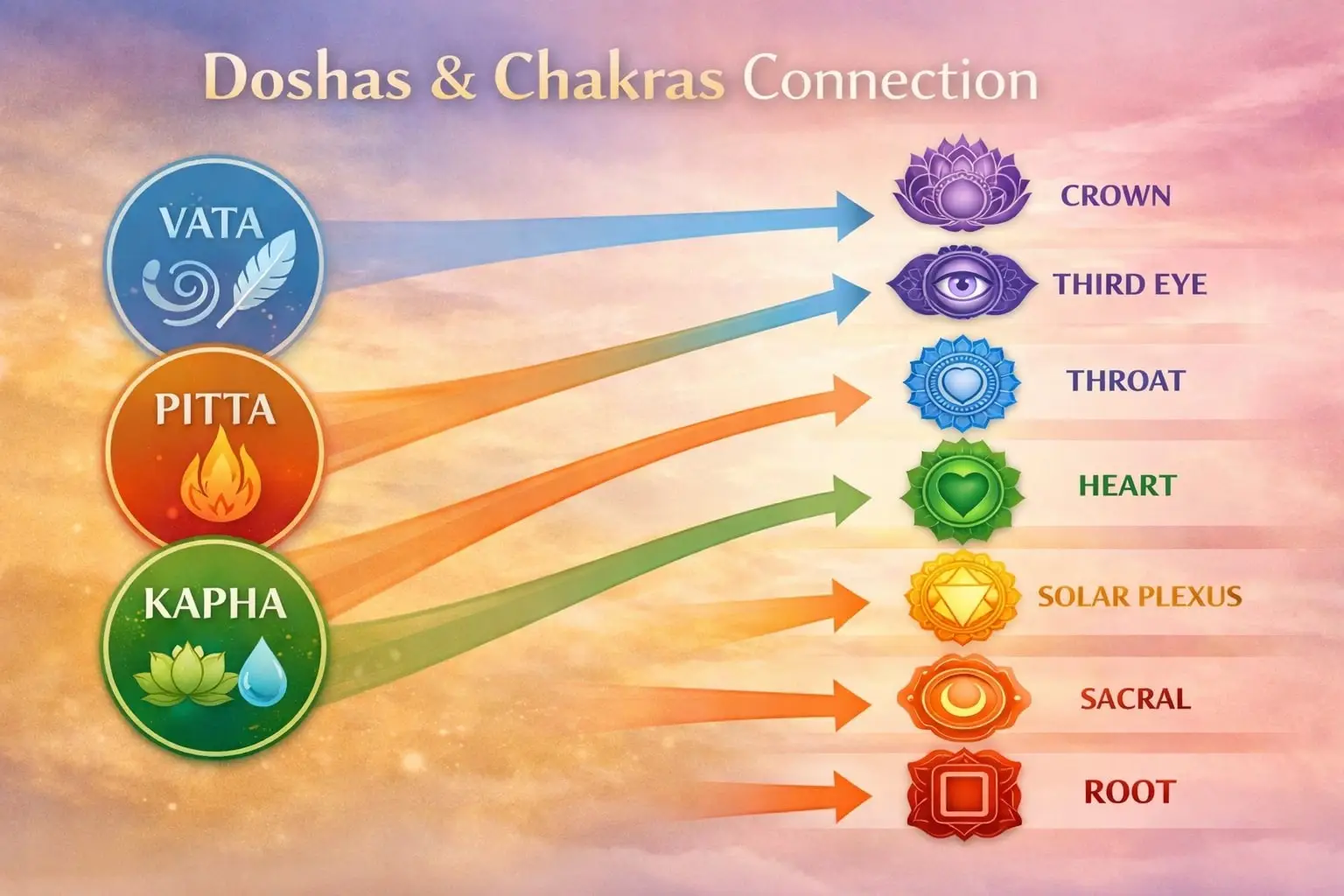
The missing link is understanding that each chakra expresses through a dominant doshic pattern.
The Dosha-Led Chakra Framework
When viewed through Ayurveda, each chakra shows a predictable relationship with one or more doshas.
At a glance, the pattern looks like this:
-
Root chakra reflects Kapha stability
-
Sacral chakra reflects Vata and Kapha flow
-
Solar plexus reflects Pitta and Agni
-
Heart reflects Pitta and Kapha balance
-
Throat reflects Vata and the nervous system
-
Third eye reflects Vata and Pitta clarity
-
Crown reflects overall integration of all three doshas
When the governing dosha is disturbed, the chakra expresses imbalance. When the dosha settles, the chakra often stops demanding attention.
Root Chakra: Safety Is Physical First
The root chakra is usually talked about in psychological terms. Ayurveda treats it as physiological.
When Kapha is depleted or unstable, people feel unsafe. Not symbolically. Practically.
Common signs include:
-
Chronic anxiety
-
Restlessness
-
Financial or survival fear
-
Difficulty settling into routines
What helps here is not visualization or affirmation. It is nourishment and rhythm.
Ayurvedic correction focuses on:
-
Warm, cooked meals
-
Regular eating times
-
Adequate fats
-
Consistent daily routines
When the body senses reliability, the nervous system relaxes. When the nervous system relaxes, the feeling of safety returns. The root chakra stabilizes as a result.
Trying to bypass this stage with fasting or aggressive detoxing often worsens instability.
Sacral Chakra: When Emotions Will Not Move
The sacral chakra governs emotional flow and creativity. Its imbalance often shows up as emotional numbness, overwhelm, or creative stagnation.
Ayurveda links this center to a Vata and Kapha dynamic. Dryness and rigidity on one side. Heaviness and attachment on the other.
Support here looks simple:
-
Warm, moist foods
-
Healthy oils
-
Cooked fruits
-
Mild sweetness
As physical digestion regains fluidity, emotional digestion often follows. This surprises many people. Emotional work becomes easier when digestion improves. Not metaphorically. Practically.
Solar Plexus: Power Without Burnout
The solar plexus is associated with confidence and will. When it is imbalanced, people often try to strengthen it by pushing harder.
More discipline. More intensity. More stimulation.
Ayurveda sees this differently. This center is governed by Pitta and Agni. When Agni is overheated or erratic, confidence turns into control, anger, or exhaustion.
Correction focuses on steadiness, not force:
-
Main meal at midday
-
Cooling and bitter foods
-
Fewer stimulants
-
Regular meal timing
In well-structured Ayurveda courses, this principle is emphasized repeatedly. True power comes from clarity and coherence, not intensity.
Heart Chakra: Digestion of Emotion
Heart imbalance rarely comes from a lack of love. More often, it comes from incomplete processing.
People either give too much and deplete themselves, or protect themselves so thoroughly that connection dries up. Grief often sits here, not because it is avoided, but because the system lacks the capacity to fully digest it.
Ayurveda supports the heart by:
-
Light but nourishing meals
-
Supporting circulation
-
Allowing emotional pacing
The heart does not open because we decide it should. It opens when the system feels supported enough to release what it has been holding.
Throat Chakra: Expression Follows the Nervous System
The throat chakra is closely tied to Vata and the nervous system. When it is disturbed, expression becomes either suppressed or scattered.
Rather than training confidence, Ayurveda focuses on calming and lubricating the system.
Warm liquids, soups, and reduced overstimulation often do more for expression than any communication technique. When the nervous system settles, speech clarifies naturally.
Third Eye: Clarity Requires Less Input
Imbalance at the third eye often shows up as overthinking and mental fatigue. People mistake imagination for intuition or feel overwhelmed by constant input.
Ayurveda responds with simplicity.
Light meals. Early dinners. Fewer sensory demands. When mental digestion completes, insight tends to arise on its own.
Crown Chakra: Integration, Not Effort
The crown cannot be forced. Attempts to activate it prematurely often lead to detachment or spiritual bypassing.
Ayurveda emphasizes integration first. When digestion, emotions, and the nervous system are aligned, awareness expands naturally. Here, dietary obsession itself can become an obstacle. Simplicity matters more than control.
What Chakra Cleansing Actually Means
Chakra cleansing is not about removing energy. It is about removing interference.
Interference often looks like:
-
Poor digestion
-
Dosha imbalance
-
Emotional backlog
-
Nervous system overload
When those clear, energy flows without effort.
This is the deeper purpose behind authentic CureNatural Ayurveda courses and serious spiritual education. Not chasing experiences. Not bypassing the body. But restoring the intelligence that governs the whole system.
Chakras, in this light, are not mystical switches. They are mirrors, quietly reflecting how well we are digesting food, emotion, and life itself.
Ayurveda does not ask us to transcend the body to reach consciousness. It asks us to listen to it first.
Related Blogs
No related blogs found.